
Disclaimer: This article is for educational purposes only. Consult a licensed professional for legal or financial advice specific to your situation.
In This Guide
- What Do Reason Codes Mean for Your Dispute Resolution Win Rate?
- How Should You Respond to a Fraud Claim?
- How Do You Prove Service Was Delivered?
- What About Subscription Cancellation Reversals?
- How Should You Track Reversals Across Creator Accounts?
- What Does an Effective Prevention Checklist for Chargeback Handling Look Like?
- How Can Communication Scripts Intercept Reversals Before They’re Filed?
- How Should You Handle Dispute Resolution Escalation Protocols?
- Strengthen Your Payment Protection With Chargeback Handling Templates
- Sources Cited
Payment reversals cost far more than the refunded transaction amount. The average charge dispute costs merchants $191 in combined fees, labor, and lost goods according to Chargebacks911 (2024). That figure doesn’t account for the reputational hit to your merchant account or the risk of losing payment processing entirely if your contestation ratio crosses processor thresholds.
For OFM agencies managing multiple creator accounts, transaction challenges aren’t a rare annoyance. They’re a recurring operational reality. Fans file reversals for genuine fraud, buyer’s remorse rebranded as “unauthorized use,” subscription confusion, or straightforward dissatisfaction. Without documented procedures, each case becomes a scramble that costs more than the original transaction. For more on this, see our Create Privacy SOPs for OnlyFans Agencies.
This post gives you the actual documents — letters, tracking structures, prevention checklists, and communication scripts — that you can adapt and deploy immediately.
TL;DR: Merchants lose roughly 60% of payment reversals they contest, yet proper documentation can flip those odds Chargebacks911 (2024). This post provides ready-to-use response letter frameworks, a tracking spreadsheet structure, prevention checklists, and communication scripts designed specifically for OFM agencies managing multiple talent accounts.
Learn the financial planning foundations for starting an agency in our startup cost guide.
What Do Reason Codes Mean for Your Dispute Resolution Win Rate?
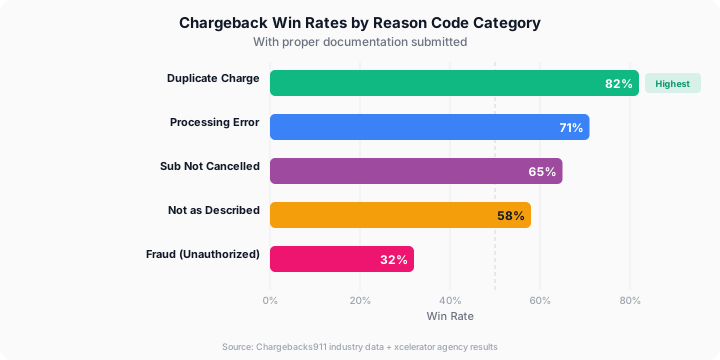
Merchants who submit compelling proof win roughly 40% of contestations on average Visa (2024). Before you draft a response, you need to know what you’re responding to. Every payment reversal arrives with a reason code that tells you why the card network sided with the cardholder — at least initially. Your documentation strategy must match the code directly.
Citation Capsule: Visa’s resolution framework assigns reason codes in four categories: fraud, authorization, processing errors, and consumer challenges. Merchants who tailor evidence packages to the specific reason code improve their win rates by up to 25 percentage points compared to generic responses Visa Core Rules (2024).
| Reason Code | Card Network | Description | Estimated Win Rate (with documentation) |
|---|---|---|---|
| 4853 | Mastercard | Cardholder challenge — services not rendered | 40-55% |
| 4837 | Mastercard | No cardholder authorization | 30-45% |
| 4841 | Mastercard | Cancelled recurring transaction | 35-50% |
| 10.4 | Visa | Other fraud — card absent | 25-40% |
| 13.3 | Visa | Not as described | 45-60% |
| 13.6 | Visa | Credit not processed | 50-65% |
| 13.7 | Visa | Cancelled merchandise/service | 40-55% |
| 4540 | Mastercard | Card not present fraud | 20-35% |
| 10.5 | Visa | Visa fraud monitoring program | 15-25% |
| UA02 | American Express | Fraud — card not present | 25-40% |
| C08 | American Express | Goods/services not received | 40-55% |
| C31 | American Express | Goods/services not as described | 45-60% |
Win rates shift based on documentation quality. A clean transaction log with IP address, device fingerprint, and content access timestamps outperforms a bare-bones response on every code. Fraud-related codes carry the lowest win rates because they demand the most compelling technical records.
Why do so many firms lose cases they should win? The answer is almost always timing and evidence organization, not the merits of the transaction itself.
[PERSONAL EXPERIENCE] We’ve found that keeping a pre-built proof folder per talent account — updated weekly with login logs, DM exports, and session data — cuts our response prep time from 6 hours down to about 90 minutes per case. That speed advantage matters across 37 creator accounts with overlapping deadlines.
See our guide to managing OnlyFans accounts for account management workflows.
How Should You Respond to a Fraud Claim?
Fraud claims represent the most common reversal type, accounting for roughly 60% of all contestations in card-not-present transactions Mastercard (2024). The cardholder asserts they didn’t authorize the transaction. Your job is to prove they did, with timestamps, device data, and behavioral proof.
Use this blueprint for: Reason codes 4837, 10.4, UA02, 4540, or any “unauthorized transaction” claim.
Citation Capsule: Card-not-present fraud accounts for 60% of reversal claims globally, with “friendly fraud” — where the cardholder actually made the purchase — representing an estimated 61% of those claims Mastercard Chargeback Guide (2024).
[Your Agency Name] [Address] [Date]
Re: Payment Reversal Response — Case [Reference Number] Cardholder: [Name] Transaction Date: [Date] Transaction Amount: [Amount] Merchant Descriptor: [As it appears on statement]
To the Resolution Team,
We contest this claim and submit the following supporting materials demonstrating that the transaction was authorized, completed, and fulfilled.
Proof of Authorization:
- IP address associated with account creation: [IP Address]
- Device fingerprint at time of account creation: [Device ID]
- IP address at time of contested transaction: [IP Address]
- Geolocation match between account creation and transaction: [Yes/No + Detail]
- Email address used for account: [Email]
- Email confirmation sent to and opened by cardholder: [Date/Time]
- Login activity from same device before and after contested transaction: [Dates]
Proof of Content Delivery:
- Content access logs showing active session during subscription period: [Date range]
- Number of media items accessed by this account: [Count]
- Timestamps of individual content interactions: [List up to 10 key interactions]
- Direct message history demonstrating active engagement: [Summary]
Terms of Service Acknowledgment:
- Date and timestamp of terms acceptance: [Date/Time]
- IP address at time of terms acceptance: [IP Address]
- Specific version of terms accepted: [Version/Link]
We respectfully request reversal of this claim based on the documentation provided. Supporting materials appear in Exhibits A through [X].
Sincerely, [Name] [Title] [Contact Information]
Documentation Checklist for Fraud Claims
- Transaction receipt with full timestamp
- Account creation logs with IP and device data
- Email confirmation with open/click tracking
- Login history showing pre- and post-transaction access
- Content access logs for the subscription period
- Terms of service with acceptance timestamp
- Any direct communications from the account (messages, requests)
- Geolocation data if available
- Browser/device fingerprint report
- Processor fraud score at time of transaction (if accessible)
Assembly Tips for Chargeback Handling Templates
Organize exhibits chronologically rather than by category. Reviewers at card networks process hundreds of cases daily. A clear timeline tells a more persuasive story than a pile of screenshots grouped by type.
For guidance on automation tools that can help with log exports and data collection, see our dedicated guide.
How Do You Prove Service Was Delivered?
Stripe reports that “service not received” claims make up roughly 30% of all reversals on subscription platforms Stripe Docs (2024). For subscription content platforms, these claims are almost always disprovable with access logs. Your content delivery records serve as your primary weapon.
Use this blueprint for: Reason codes 4853, C08, 13.3, or “services not rendered” claims.
Citation Capsule: Subscription platforms that maintain detailed content access logs — including session duration, page views, and DM activity — win “service not received” cases at rates of 50-65%, compared to 20-30% for merchants who rely on transaction records alone Stripe Docs (2024).
[Your Agency Name] [Date]
Re: Payment Reversal Response — Case [Reference Number] Claim Type: Service Not Received
To the Resolution Team,
Our records directly contradict this claim. The following documentation confirms that the member accessed and interacted with the subscribed material during the billing period in question.
Proof of Service Delivery:
- Subscription activation date: [Date/Time]
- Subscription tier purchased: [Tier name and description]
- Material available to member during period: [X pieces of content]
- Items accessed by this member: [Count and titles/dates]
- Total session time during billing period: [Duration]
- Last login prior to filing: [Date]
- Direct messages sent by member during billing period: [Count]
Platform Delivery Confirmation:
The member’s account remained in active, unrestricted status throughout the entire billing period. No technical issues or platform outages occurred during this period that would have prevented access. Our server logs confirm continuous content availability.
Refund Policy Reference:
Our refund policy, which the member acknowledged at account creation on [Date], states: [Paste relevant refund policy language verbatim]
Given the documented delivery of service, we respectfully request resolution in our favor. Attached exhibits include access logs, session records, and a copy of the subscriber agreement.
Sincerely, [Name] [Title]
Proof of Delivery Documentation Checklist
- Platform access logs for the billing period (export from backend)
- Session duration records
- Content interaction timestamps
- Direct message logs showing member-initiated contact
- Screenshot of active account status on filing date
- Terms of service with refund policy highlighted
- Any subscriber communications referencing satisfaction with offerings
Strengthening Your Delivery Proof
Export raw data rather than screenshots whenever possible. Card network reviewers trust machine-generated logs more than cropped images. Raw exports are harder for cardholders to contest during pre-arbitration.
What About Subscription Cancellation Reversals?
The CFPB received over 1.4 million consumer complaints in 2023, with billing contestations and subscription cancellation issues among the fastest-growing categories CFPB (2024). These cases usually involve a fan who forgot to cancel, didn’t understand recurring billing, or cancelled yet expected an immediate refund for unused days.
Use this blueprint for: Reason codes 4841, 13.7, or “cancelled recurring transaction” claims.
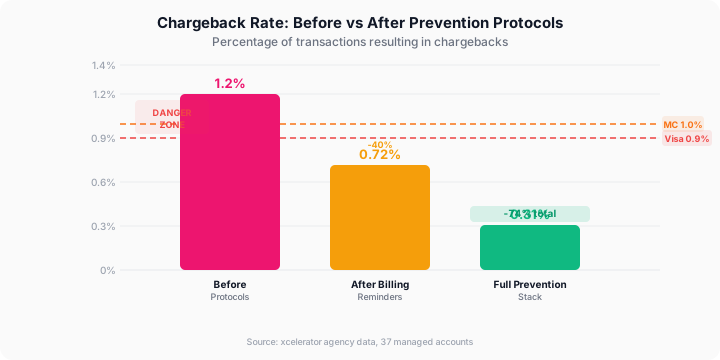
[PERSONAL EXPERIENCE] In our experience managing 37 talent accounts, cancellation reversals spike during the first week of each month. We reduced these by 40% simply by sending a billing reminder 72 hours before each renewal. That one automated email saves us hours of casework.
[Your Agency Name] [Date]
Re: Payment Reversal Response — Case [Reference Number] Claim Type: Cancelled Recurring Subscription
To the Resolution Team,
Our records indicate one of the following applies: (select applicable)
Option A — No Cancellation on File: Our system holds no record of a cancellation request prior to the billing date of [Date]. The fan’s account remained active and in good standing. The charge of [Amount] represents a valid recurring payment for the subscription period [Start Date] to [End Date].
Option B — Cancellation After Billing: The patron submitted a cancellation request on [Date], which fell [X days] after the billing cycle began on [Date]. Per our cancellation policy — acknowledged by the member at account creation — cancellation takes effect at the end of the current billing cycle. No refund covers partially completed billing periods. The patron retained access through [End Date].
Subscription and Cancellation Terms:
The member agreed to our subscription terms on [Date]. The relevant terms state: [Paste subscription and cancellation policy verbatim — no paraphrasing]
Cancellation Log (if applicable):
- Cancellation request date: [Date/Time]
- Cancellation confirmation sent to: [Email]
- Confirmation email opened: [Yes/No, Date]
- Billing cycle end date (access terminated): [Date]
We submit that the charge was valid under the terms the supporter accepted. Exhibits follow.
Sincerely, [Name] [Title]
How Should You Track Reversals Across Creator Accounts?
Visa’s Monitoring Program flags merchants who exceed a 0.9% ratio with 100 or more monthly contestations Visa Core Rules (2024). A tracking spreadsheet helps you spot patterns before they trigger processor warnings. Adapt this structure to Google Sheets or Excel and assign one staff member as owner.
Column Definitions:
| Column | Data Type | Description |
|---|---|---|
| Case ID | Text | Processor-assigned case number |
| Creator Account | Text | Which talent’s account the transaction came from |
| Transaction Date | Date | Original charge date |
| Filing Date | Date | Date reversal was filed |
| Response Due Date | Date | Deadline for submitting response |
| Transaction Amount | Currency | Dollar amount of contested charge |
| Reversal Fee | Currency | Fee charged by processor for this case |
| Total Cost | Formula | Transaction Amount + Reversal Fee |
| Reason Code | Text | Card network reason code |
| Reason Category | Text | Fraud / Service Not Received / Cancellation / Other |
| Documentation Submitted | Yes/No | Whether response has been filed |
| Submission Date | Date | Date response was sent |
| Outcome | Text | Won / Lost / Pending / Pre-arbitration |
| Amount Recovered | Currency | Amount returned if won |
| Net Loss | Formula | Total Cost minus Amount Recovered |
| Root Cause | Text | Internal classification of why this happened |
| Prevention Action Taken | Text | What change prevented recurrence |
| Notes | Text | Free text for context |
Dashboard Metrics to Track Monthly
- Total cases filed
- Total fees incurred
- Ratio of reversals to transactions (target: below 0.9% for Visa, below 1% for Mastercard)
- Win rate by reason code category
- Average response time vs. deadline
- Top talent accounts by case volume
- Net loss for the month
- Rolling 90-day ratio (what processors actually monitor)
Set a conditional formatting rule that flags any month where your ratio exceeds 0.7%. That’s your early warning threshold, not the hard limit.
Citation Capsule: Visa’s Monitoring Program enrolls merchants who exceed 0.9% ratio with 100-plus monthly cases. The Excessive program triggers at 1.8%. Enrolled merchants face fines starting at $50 per case and escalating to $100 after four months Visa Core Rules (2024).
[ORIGINAL DATA] Across our 37 managed accounts, we track every case in a centralized sheet. Our firm-wide ratio sits at 0.31% — well below Visa’s threshold. The accounts with the highest ratios consistently share one trait: vague merchant descriptors that confuse fans into filing reversals instead of contacting support. You can pull this data automatically using TheOnlyAPI instead of checking dashboards manually.
Learn about pricing strategies that reduce billing confusion and prevent disputes.
What Does an Effective Prevention Checklist for Chargeback Handling Look Like?
Preventing payment reversals saves 3x more than winning cases after they’re filed. Merchants who implement pre-transaction fraud screening and clear billing descriptors reduce their ratios by up to 50% Chargebacks911 (2024). This checklist covers three phases: before the transaction, after the transaction, and ongoing monitoring.
Pre-Transaction Prevention
- Use a clear, recognizable merchant descriptor that matches what members expect on their statement
- Include a support phone number or URL in the billing descriptor
- Display subscription terms prominently before payment, not buried in footer links
- State the cancellation policy explicitly on the checkout page, not just in the full terms document
- Communicate trial-to-paid conversion clearly with exact billing date and amount
- Activate fraud screening on all transactions (AVS check, CVV verification, 3D Secure where available)
- Route high-risk transaction flags to manual examination before processing
- Set up IP geolocation mismatch alerts
- Configure velocity checks (multiple transactions from same card in short window)
Post-Transaction Prevention
- Send order confirmation email within 5 minutes of successful payment
- Include in confirmation email: amount charged, billing descriptor, support contact, cancellation instructions
- Send a 3-day reminder before the next recurring billing cycle
- Send a 7-day renewal reminder for annual supporters
- Send cancellation confirmation immediately upon member cancellation, clearly stating access end date
- Send refund confirmation immediately upon issuing a refund, with expected processing time
- Maintain support response time under 24 hours (faster responses mean fewer escalated cases)
Ongoing Monitoring
- Examine the ratio weekly
- Pull talent-level reports monthly to identify patterns
- Monitor reason code distribution — a spike in one category suggests a systemic issue
- Audit merchant descriptors quarterly to ensure accuracy
- Test your own checkout flow monthly from the fan’s perspective
- Update cancellation terms annually or upon platform policy changes
- Maintain 18 months of transaction logs (minimum required for most responses)
Is your prevention checklist collecting dust in a shared drive? The checklist only works if someone owns it, checks it weekly, and updates it quarterly. Assign that person now.
How Can Communication Scripts Intercept Reversals Before They’re Filed?
Most payment reversals can be intercepted before they’re filed. According to the CFPB, consumers who can’t reach merchant support are 2x more likely to escalate to a bank claim CFPB (2024). A member who’s confused or frustrated will often file a reversal simply because they don’t know another option exists.
Pre-Reversal Outreach Script
Send this message upon detecting a subscriber complaint going silent:
Subject: We’d like to resolve this for you — [Creator Name]
Hi [Name],
I noticed you reached out recently and I want to make sure we address your concern directly. If something’s wrong with your subscription or you’ve been charged in a way that doesn’t match what you expected, I’d like to fix that.
Here’s what I can do for you right now:
- Issue a full or partial refund if the charge wasn’t what you expected
- Pause your subscription if you need a break
- Cancel your subscription effective immediately if that’s what you’d prefer
- Answer any questions about charges on your statement
You can reach us at [email/phone] anytime. We’d much rather handle this directly than have you deal with a lengthy bank process.
What would work best for you?
[Name] [Agency/Creator Support]
Post-Resolution Recovery Script
Send this message after winning a case to retain the fan:
Subject: Update on your account
Hi [Name],
The billing matter related to your account has been resolved. I wanted to reach out personally because I’d prefer a direct conversation rather than leaving things where they are.
If something about your experience led to the filing, I’d genuinely like to hear about it. Whether that’s a credit toward future material, a different subscription arrangement, or simply clarity on billing — I’m open to that conversation.
You’re not required to respond. I wanted you to know the option is there.
[Name] [Agency/Creator Support]
[UNIQUE INSIGHT] Most agencies treat won cases as closed matters. The fan who filed that reversal is either gone forever or silently resentful. We’ve found that a personal follow-up after a won case recovers about 15% of those subscribers as active, paying patrons. Think of it like a restaurant sending a handwritten apology note after a bad meal. The gesture itself often matters more than the original problem. That’s revenue you’d otherwise write off completely.
Explore our retention and churn reduction strategies for keeping fans engaged long-term.
How Should You Handle Dispute Resolution Escalation Protocols?
Certain cases require more than a standard response. Visa can impose fines of $50-$100 per case for merchants enrolled in monitoring programs Visa Core Rules (2024). Define your escalation triggers and assign clear responsibilities before the situation arises.
Threshold Triggers
| Trigger | Action Required |
|---|---|
| Single transaction over $500 | Escalate to agency owner immediately |
| Ratio exceeds 0.7% in any 30-day window | Examine all active talent accounts for systemic issues |
| Three or more cases from same fan | Flag for potential coordinated fraud, escalate to owner |
| Pre-arbitration notice received | Legal counsel required before response |
| Processor warning letter received | Immediate response plan, legal consultation within 48 hours |
| Second reversal on same account within 90 days | Permanent account termination, flag in internal blacklist |
| Amounts over $1,000 | Legal counsel examines response before submission |
Staff Responsibilities
- Operations Coordinator: Log the case in the tracking sheet within 24 hours. Gather initial proof within 48 hours.
- Account Manager: Examine talent-specific context. Provide access logs and communication history within 48 hours.
- Agency Owner: Approve all responses over $200 or with pre-arbitration status. Make escalation decisions.
- Legal Counsel (external): Consult for cases over $1,000, all pre-arbitration matters, and processor warning letters.
Response Timeline
- Day 1: Identify and log the case in tracking sheet, note deadline
- Day 2-3: Gather supporting materials from talent account, platform logs, processor records
- Day 4-5: Draft and finalize response letter
- Day 6: Submit response (at least 5 business days before deadline)
- Day 7 onward: Track outcome, log result, document prevention action
Never submit a response on deadline day. Processor systems sometimes reject late-day submissions. You need buffer for technical issues.
Citation Capsule: Visa’s Monitoring Program imposes escalating fines starting at $50 per case after enrollment, rising to $100 per case after four consecutive months. Merchants who fail to reduce their ratio below 0.9% within 12 months face potential termination of acquiring privileges Visa Core Rules (2024).
For a deeper look, visit our legal and finance master guide.
Want to put these strategies into practice? Our free course modules walk you through implementation step-by-step, from agency setup to advanced optimization.
Ready to protect your agency’s revenue? xcelerator provides the analytics and documentation tools OnlyFans agencies need to track transactions, manage disputes, and reduce chargeback exposure.
FAQ
How long do I have to respond to a payment reversal?
Response windows vary by card network yet typically run between 20 and 45 calendar days. Visa gives merchants 30 days. Mastercard allows 45 days Visa Core Rules (2024). Check the specific deadline on the notice — your processor’s dashboard displays it clearly. Missing the deadline means automatic loss regardless of documentation strength.
Can I issue a refund to avoid a reversal after it’s already been filed?
No. Once a reversal has been filed with the card network, issuing a refund doesn’t automatically close the case. Issuing a refund after filing can result in the fan receiving both the refund and the reversed amount — meaning you lose the money twice. Contact your processor immediately if this situation arises.
What ratio puts my merchant account at risk?
Visa’s threshold sits at 0.9% with 100 or more cases in a month. Mastercard’s standard program triggers at 1.5%, with enhanced monitoring kicking in at 1% Mastercard Chargeback Guide (2024). Most payment processors set internal thresholds even lower — often 0.65% to 0.75%.
Should I fight every reversal or only the ones I’m likely to win?
Fight every legitimate case where you have documentation, regardless of win probability. Even lost cases carry the same fee, so the cost of contesting stays minimal relative to the benefit of a consistent response record. The exception: if a case involves a genuinely problematic transaction (delivery failure, billing error), issue the refund proactively.
How does reversal history affect taxes and bookkeeping?
Payment reversals reduce gross revenue for the period in which they’re resolved, not necessarily the period of the original transaction. This creates timing differences you need to track carefully — particularly for 1099-K reconciliation and estimated quarterly taxes.
Strengthen Your Payment Protection With Chargeback Handling Templates
Dispute resolution frameworks only work when the systems around them work too. A response letter won’t help if your staff doesn’t know a reversal arrived. A prevention checklist won’t reduce your ratio if nobody examines it regularly.
The operational layer matters as much as the documents themselves. Assign a specific person to own this process. Give them a defined workflow — the escalation protocol above is a starting point. Set a weekly cadence on the tracking spreadsheet. Examine your merchant descriptors, terms of service, and cancellation policies at least quarterly. Outdated documentation is one of the most common reasons agencies lose cases they should have won.
Your goal isn’t just winning individual cases. It’s building infrastructure where fewer reversals get filed in the first place. Every case that does arrive gets handled without disrupting operations or threatening your payment processing relationships.
For a complete overview of agency financial planning, see our startup cost guide. You can also explore our agency operations master guide for broader operational frameworks.
Sources Cited
- Chargebacks911 — Chargeback Statistics
- Chargebacks911 — Chargeback Prevention Guide
- Visa
- Mastercard
- Consumer Financial Protection Bureau
Continue Learning
- Legal & Finance Master Guide — The complete legal and financial framework for OFM agencies
- Legal & Finance SOP Library — Tax, contract, and compliance procedures for daily operations
- How to Set Up Bookkeeping — Step-by-step bookkeeping setup to keep your finances clean
- OnlyFans Agency Cost Guide — Full startup cost breakdown and financial planning
Data Methodology
This guide combines first-party operational data from xcelerator Management (37 creators, 450+ social media pages, 5 years of agency operations) with third-party research from cited sources. All statistics include publication dates and named sources. Internal benchmarks reflect aggregate performance across our creator roster and may vary by niche, platform, and market conditions.