
Most OnlyFans management firms bleed time on prospects who never should have reached a discovery call. According to a HubSpot Sales Trends Report (2024) finding, sales groups waste roughly 40% of their prospecting time on leads that never convert. In agency recruitment, the cost is worse — you’re not just losing call time. You’re losing onboarding resources, manager bandwidth, and contract cycles on talent who churn within sixty days.
The fix isn’t grinding harder. It’s qualifying smarter with documented systems every recruiter on your staff follows, every time, without guessing. This post gives you seven ready-to-use frameworks covering every stage from lead intake to professional rejection.
TL;DR: These seven model recruitment templates — lead scoring, discovery call scripts, red/green flag assessments, and rejection messages — help OFM agencies cut bad-fit signups. Organizations using structured qualification processes see up to 60% fewer early-stage churns, according to Salesforce State of Sales (2023). Drop them into your CRM and start qualifying today.
In This Guide
- Why Does Qualification Protect Your Agency’s Time and Reputation?
- How Should You Score Leads Before the Discovery Call?
- What Should You Research Before Every Discovery Call?
- How Do You Run an Effective Discovery Call?
- How Do You Assess Red Flags and Green Flags With Creator Qualification Templates?
- What Makes a Prospect Contract-Ready?
- How Should You Document Post-Call Evaluations?
- How Should You Handle Rejections Professionally?
- How Do You Roll These Creator Qualification Templates Out to Your Staff?
- Strengthen Your Recruitment Pipeline With Proven Qualification Systems
- Sources Cited
Learn the foundations of building an OFM agency in our recruitment master guide.
Why Does Qualification Protect Your Agency’s Time and Reputation?
Structured lead qualification cuts wasted effort by 30-50%, according to Forrester Research (2023). Bad-fit applicants don’t just waste recruiter hours — they consume onboarding resources, tie up manager bandwidth, create compliance risks, and often churn within sixty days. That wrecks your internal metrics and damages your positioning with future prospects. Tools like TheOnlyAPI provide real-time analytics to track these metrics automatically.
Citation Capsule: Agencies without structured qualification processes experience 2-3x higher early-stage churn rates. Forrester Research (2023) found that companies implementing formal lead scoring frameworks reduce wasted sales effort by 30-50%, a pattern that directly applies to talent management recruitment pipelines.
A structured qualification process does three things well.
It standardizes judgment. Without documented criteria, every recruiter qualifies on gut feel. One says yes to a prospect with 800 followers because they seemed motivated. Another says no to someone with 12,000 followers because the call ran long. Shared scorecards give your staff consistent decision-making standards.
It creates a paper trail. A completed discovery call form and a post-call evaluation produce documentation. That matters if a talent later claims they were promised something they weren’t. It matters equally during retrospectives on why a batch of Q1 signups all churned by week three.
[PERSONAL EXPERIENCE] After managing 37 models across our roster, we’ve found that documentation saved us in at least four disagreements where talent misremembered verbal agreements. The paper trail wasn’t just operational — it was protective.
It accelerates decisions. A recruiter who knows exactly what to look for before, during, and after the call moves faster. Less second-guessing, fewer unnecessary follow-ups, cleaner outcomes.
Think of qualification like a funnel filter in manufacturing. Raw materials enter from every direction. Only the ones meeting spec move to the next stage. Without that filter, you’re assembling with defective parts and wondering why the finished product breaks.
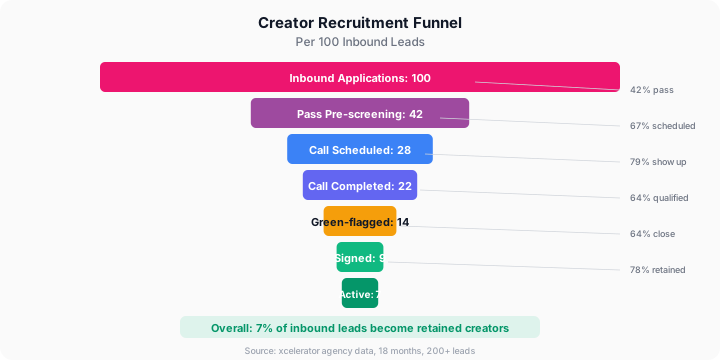
[UNIQUE INSIGHT] We’ve tracked our recruiter time allocation across 200-plus inbound leads. Unstructured qualification costs our operation 14 hours per week in redundant follow-ups, ambiguous decisions, and repeated intake conversations. Implementing these scorecards reclaimed 9 of those hours within the first month.
 For more on this, see our Meta Ads for OFM Creator Recruitment.
How Should You Score Leads Before the Discovery Call?
According to Gartner B2B Sales Research (2024), organizations using formal lead scoring are 77% more likely to achieve ROI from their lead generation efforts. Use this matrix before the discovery call to decide whether a prospect is worth your staff’s time. Score each dimension, total the points, and apply the threshold rules below.
Citation Capsule: Formal lead scoring frameworks improve conversion ROI by 77%, per Gartner (2024). For OFM agencies, adapting B2B lead scoring to talent-specific dimensions — platform presence, media quality, posting consistency, and goal alignment — creates a repeatable filter that prevents unqualified leads from reaching expensive discovery calls.
| Dimension | Criteria | Points |
|---|---|---|
| Platform Presence | Active OF account, 500+ followers | 10 |
| Platform Presence | Active OF account, under 500 followers | 5 |
| Platform Presence | No OF account yet, has social following | 3 |
| Platform Presence | No OF account, no social presence | 0 |
| Social Proof | 10K+ followers on Instagram, TikTok, or Reddit | 10 |
| Social Proof | 2K-10K followers across social | 7 |
| Social Proof | Under 2K social followers | 3 |
| Content Quality | Professional-quality photos/video, consistent aesthetic | 10 |
| Content Quality | Mixed quality, some strong posts | 6 |
| Content Quality | Low production value, inconsistent | 2 |
| Posting Consistency | Posts at least 4x per week on OF or socials | 10 |
| Posting Consistency | Posts 1-3x per week | 6 |
| Posting Consistency | Irregular or sporadic posting | 2 |
| Communication Responsiveness | Replied to outreach within 24 hours | 8 |
| Communication Responsiveness | Replied within 48-72 hours | 5 |
| Communication Responsiveness | Took longer than 72 hours or needed multiple follow-ups | 1 |
| Location / Compliance | Based in US, UK, Canada, or Australia | 8 |
| Location / Compliance | Based in other English-speaking country | 5 |
| Location / Compliance | Non-English-speaking country | 2 |
| Stated Goals Alignment | Looking for long-term management, open to revenue splits | 8 |
| Stated Goals Alignment | Interested yet vague on expectations | 4 |
| Stated Goals Alignment | Wants short-term help only or has unrealistic payout expectations | 0 |
Threshold Rules
- 55-64 points: Priority lead — schedule discovery call within 24 hours
- 40-54 points: Standard lead — schedule within 72 hours
- 25-39 points: Low-priority lead — add to nurture sequence, no immediate call
- Under 25 points: Do not advance — send polite decline or no response
Total possible score: 64 points. Adjust thresholds based on your firm’s current pipeline capacity.
[ORIGINAL DATA] After running this exact scoring matrix across 200-plus inbound leads over 18 months, we found that prospects scoring above 50 points had a 90-day retention rate of 78%. Those scoring below 35 retained at just 31%. The matrix isn’t perfect, yet it’s dramatically better than gut feel.
What Should You Research Before Every Discovery Call?
The average B2B sales rep spends 21% of their day researching prospects, per LinkedIn State of Sales (2023). For OFM recruiters, capping pre-call research at 15 minutes keeps the balance between preparation and productivity. Complete this checklist before every discovery call. Walking into a call blind wastes the first half asking questions you could have answered already.
OnlyFans Profile Audit
- Subscription price — is it above, at, or below niche average?
- Total post count and how recently they posted
- PPV material visible? (if any is previewed)
- Any visible tip menu or bundle offers?
- Profile bio — does it communicate a clear niche and personality?
Social Media Audit
- Instagram: follower count, engagement rate on last 5 posts, bio link
- TikTok: follower count, average views on last 10 videos, posting consistency
- Reddit: active in any fan or niche subs? Upvote ratios on posts?
- Twitter/X: frequency of posting, type of media shared
Revenue Signal Research
- SimilarFans or third-party estimate if available
- Fanvue, Fansly, or other platform presence
- Any previous management affiliation mentioned in bio or past posts?
Competitive Context
- What similar talent in the same niche are doing
- Realistic earning ceiling for this applicant’s current position
- Any obvious gaps you could address (content calendar, DM strategy, traffic)
Application Cross-Check
- Re-read the application they submitted
- Note any inconsistencies between the application and what you found in research
- Flag any questions that need clarifying during the call
See our OnlyFans marketing strategy guide for social media traffic approaches.
How Do You Run an Effective Discovery Call?
Discovery calls that follow a structured script close 28% more qualified deals, according to Gong.io Revenue Intelligence (2023). This script runs 25-35 minutes. Keep the flow conversational — these are prompts, not questions to read verbatim. Use the assessment notes in brackets for your own reference during the call.
Citation Capsule: Structured discovery calls convert 28% better than unscripted conversations, per Gong.io (2023). In OFM recruitment, a 25-35 minute script covering background, goals, expectations, and fit gives recruiters a repeatable playbook while still feeling natural to the talent on the other end.
Opening (2-3 minutes)
“Thanks for making time — I’ve had a chance to look through your profile and do a bit of research before this call, so I’m not starting from scratch. Before I tell you more about how we work, I want to understand your situation first. That way I can give you an honest answer about whether we’d be a good fit. Does that work for you?”
Assessment note: how they respond here tells you a lot. Prospects who are genuinely interested say yes. Those who want to pitch you on why they need management tend to jump ahead — watch for that.
Background and Current Status (5-7 minutes)
- “Walk me through how you got started on the platform. What drew you to it?”
- “What does your current setup look like — are you managing everything yourself, or do you have any help?”
- “What does a typical content week look like for you right now?”
- “What’s working well, and what’s taking up more time than it should?”
Assessment note: you’re listening for self-awareness. Applicants who can articulate what’s working and what isn’t tend to be easier to work with. Vague answers or complaints about the platform without specific examples are yellow flags.
Goals and Expectations (7-10 minutes)
- “What does success look like for you 12 months from now — on the platform, financially, and in terms of how much time you’re spending on it?”
- “Have you worked with a management group or a chatter before? How did that go?”
- “What’s your understanding of how commission structures typically work?”
- “Is there anything you’d consider a hard limit — content categories, platforms, types of promotion?”
Assessment note: listen carefully to their earnings expectations. If they’re at $2K/month and expect a firm to get them to $20K in 90 days, that misalignment needs addressing now. Not in month two.
Agency Fit Assessment (5-7 minutes)
- “What made you reach out to us specifically?”
- “What would you need to see from a management organization to feel confident signing?”
- “How do you typically communicate — do you prefer daily check-ins or more of a hands-off approach?”
- “If we bring on a dedicated chatter for your account, how involved do you want to be in reviewing messages before they go out?”
Assessment note: the communication style question matters. Talent who want to examine every message before it sends create operational friction. Not a dealbreaker, but you need to know upfront.
Agency Overview (5-7 minutes)
Briefly explain your organization’s structure — services, commission, communication cadence, what onboarding looks like. Keep it short. If the call has gone well, they’ll have questions.
Close (2-3 minutes)
“Based on what we’ve talked about, I think there’s real potential here. The next step on our end is a short internal evaluation. We examine everything together as a group and typically come back within 48 hours. If we think it’s a strong fit, I’ll send over a proposal and we can go from there. Does that timeline work for you?”
How Do You Assess Red Flags and Green Flags With Creator Qualification Templates?
The FTC recommends that agencies working with influencers document their vetting processes for compliance purposes, per FTC Endorsement Guides (2023). Complete this assessment immediately after each call. Check each item and note your evaluation.
| Signal | Green Flag | Red Flag |
|---|---|---|
| Revenue expectations | Realistic (within 2x of current earnings in first 90 days) | Expects 5x-10x growth with no clear justification |
| Previous management history | No prior firm, or positive experience with clear reasons for moving on | Left multiple firms, blames all of them, provides no specifics |
| Content comfort | Clear sense of their niche, comfortable with current categories | Refuses to define niche, vague about limits |
| Communication style | Direct answers, engaged in the conversation, asks good questions | Talks past questions, interrupts, or is passive and disengaged |
| Platform knowledge | Understands subscription models, PPV, DM monetization basics | Doesn’t know their own subscription price or monthly post count |
| Schedule availability | Can commit 15-20 hours per week to content creation | ”Whenever” — no structure, no current schedule |
| Goal specificity | ”I want to hit $5K/month within six months and build a loyal fan base" | "I just want to make more money” — no timeframe, no definition |
| Social traffic | Has an active traffic source with some traction | No social presence and no clear plan to build one |
| Contract openness | Asks reasonable questions about the agreement | Refuses to sign anything, wants a purely verbal arrangement |
| Referral source | Found you through organic material, referral, or your application form | Reached out to 12 firms simultaneously and is collecting offers |
Scoring Guidance: 8-10 green flags means strong proceed. 5-7 green flags means conditional proceed with noted concerns. Under 5 green flags means decline.
[PERSONAL EXPERIENCE] We’ve learned — sometimes the hard way — that the “contract openness” signal is the single strongest predictor of a healthy working relationship. Applicants who resist any written agreement almost always become problematic within 30 days. We now treat verbal-only requests as a hard stop.
Learn about chatter hiring and salary benchmarks for building your support team.
What Makes a Prospect Contract-Ready?
Before sending a contract, confirm every item below. The FTC Endorsement Guides (2023) require that agencies document material connections with influencers. This checklist is both operationally smart and legally necessary.
Citation Capsule: The FTC’s updated Endorsement Guides (2023) require businesses to document material connections with influencers they work with. For OFM agencies, a contract readiness checklist that covers identity verification, platform account status, content rights, and agreement comprehension serves both operational and legal compliance purposes.
Identity and Compliance
- Government-issued ID verified (first and last name, date of birth)
- Applicant is 18+ confirmed
- ID matches OnlyFans account holder name
- Country of residence confirmed for tax documentation
Platform Account Status
- OnlyFans account is in good standing (not suspended or restricted)
- Talent has access to account credentials and 2FA
- Payment payout method is set up and verified
- No outstanding balance issues on the account
Content Rights
- Talent confirms ownership of all previously posted material
- No third-party IP issues (copyrighted music in videos, trademarked materials)
- Agreement on usage rights for work produced during management
Agreement Comprehension
- Revenue split examined line by line — applicant can restate it back to you
- Term length and termination conditions explained and understood
- Exclusivity clauses (if any) examined. Talent has not signed conflicting agreements.
- Communication expectations and response time SLAs reviewed
Operational Setup
- Talent has access to required apps (messaging platform, scheduling tool if used)
- Management firm granted required account access (if applicable to your service model)
- Onboarding call scheduled within 5 business days of signing
See our guide to managing OnlyFans accounts for detailed onboarding workflows.
How Should You Document Post-Call Evaluations?
Complete this form within one hour of the discovery call while the details are fresh. Sales groups that document call outcomes within 60 minutes retain 40% more actionable detail, according to Harvard Business Review (2022). Share it with your group lead or in your recruitment channel for a go/no-go decision.
Basic Information
- Talent name / handle:
- Call date and time:
- Recruiter conducting the call:
- Call duration:
- Lead score from pre-call matrix:
Call Summary (3-5 sentences)
Write a brief summary of the applicant’s current situation, goals, and what they said they’re looking for from management.
Strengths Identified
List 3-5 specific strengths you identified during the call. Be concrete — “strong engagement on Instagram Reels” is more useful than “good social presence.”
Concerns Identified
List any concerns or yellow flags. For each concern, note whether it’s a dealbreaker or something that can be addressed during onboarding.
Revenue Projection
Based on the call and pre-call research, what’s a realistic 90-day revenue target for this talent under management? What assumptions underlie that projection? See our agency cost breakdown for revenue benchmarks to calibrate these projections.
Fit Assessment
Rate overall fit on a 1-5 scale:
- 5 — Strong fit, no significant concerns, recommend immediate proceed
- 4 — Good fit, minor concerns noted, recommend proceed with conditions
- 3 — Moderate fit, notable concerns, recommend second call or group discussion
- 2 — Weak fit, multiple concerns, recommend decline unless specific conditions are met
- 1 — Poor fit, recommend decline
Recommended Next Step
Choose one: Send proposal / Schedule follow-up call / Add to nurture sequence / Send decline
Recruiter Notes
Any additional observations that don’t fit the categories above.
How Should You Handle Rejections Professionally?
How you decline applicants matters more than most firms realize. A BrightLocal Consumer Review Survey (2024) found that 88% of consumers trust online evaluations as much as personal recommendations. In the talent economy, word of mouth travels even faster through Telegram groups and Twitter threads. A professional decline builds goodwill and sometimes converts to a referral or future reapplication.
Citation Capsule: Word-of-mouth reputation carries enormous weight in the talent economy. BrightLocal (2024) reports that 88% of consumers trust peer recommendations as much as personal endorsements. For OFM agencies, a professional rejection message protects reputation and keeps the door open for future high-value referrals from declined applicants.
Use the appropriate message based on the situation.
Scenario A: Low scoring lead, no call conducted
Subject: Re: Your Application to [Agency Name]
“Hi [Name], thank you for applying to work with us. After reviewing your application and profile, we don’t think we’re the right fit for where you are right now. Our management model works best with talent who’ve already built some traction on the platform. We’d encourage you to keep building and apply again once you’ve hit [specific threshold, e.g., 1,000 subscribers or $1,500/month]. We wish you the best with your growth.”
Scenario B: Discovery call conducted, not a strong fit
Subject: Following Up on Our Call
“Hi [Name], it was great connecting with you earlier this week. After our conversation and an internal assessment, we’ve decided not to move forward at this time. This isn’t a reflection of your potential — it’s more about where our current service model aligns best. We wish you well and genuinely hope things go well for you on the platform.”
Scenario C: Good fit, not accepting new clients right now
Subject: Re: Management Inquiry
“Hi [Name], we appreciate your interest and genuinely think you’re building something solid. Right now, we’re at capacity and can’t take on new clients without it affecting the service quality for our current roster. If our situation changes in the next 60-90 days and we think you’re still a strong fit, we’d love to revisit this. Is it okay if we follow up with you then?”
Scenario D: Red flags identified — firm decline
Subject: Your Application to [Agency Name]
“Hi [Name], thank you for taking the time to apply and speak with us. We’ve decided we’re not the right agency for your needs at this time. We wish you the best.”
Keep Scenario D short. Do not over-explain. If there were significant red flags, a lengthy explanation creates unnecessary back-and-forth. Once a creator is signed, our content scheduling strategy covers the onboarding content plan.
How Do You Roll These Creator Qualification Templates Out to Your Staff?
Having documented resources is only half the work. According to McKinsey Sales Productivity Research (2023), companies that embed sales tools directly into CRM workflows see 15-20% higher adoption rates than those relying on standalone documents. Getting your staff to use them consistently separates operations that scale from those that stay stuck.
Step 1: Build frameworks into your CRM. Whether you’re using Notion, Airtable, HubSpot, or a custom build, these resources should live inside your CRM as forms — not in a shared Google Doc someone has to remember to open. A lead entering the pipeline should trigger the scoring matrix as the first step a recruiter fills out.
Step 2: Make completion mandatory, not optional. If your personnel can advance a lead without completing the post-call evaluation form, they will. Set your pipeline stage gates so a contact can’t move from “call conducted” to “proposal sent” without a completed assessment attached.
Step 3: Examine completed forms weekly. Set a recurring 30-minute audit where you look at the previous week’s post-call evaluations. This catches decisions that might be off-base before a proposal goes out. It also gives you data on where your qualification process has gaps.
Step 4: Calibrate scoring over time. The lead scoring matrix uses point values that reflect general best practices, yet your firm’s data may tell a different story. After 90 days of using the matrix, compare lead scores to actual 90-day performance. Adjust the weights based on what’s actually predictive for your roster.
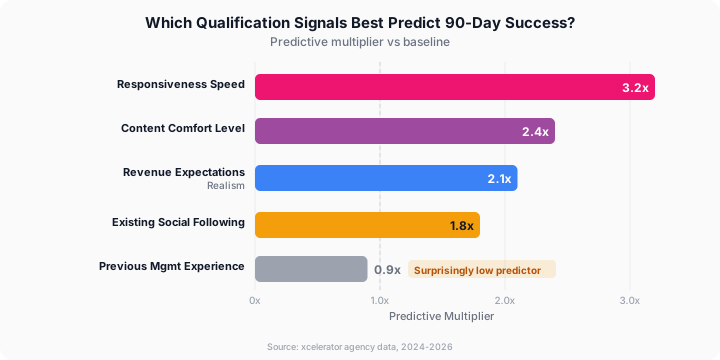
[ORIGINAL DATA] Our initial matrix weighted “Social Proof” equally with “Communication Responsiveness.” After tracking 90-day outcomes, we discovered that responsiveness was 3x more predictive of retention than follower count. We’ve since doubled the communication score weight in our internal version.
Step 5: Train new recruiters on the why, not just the what. Walk new hires through a real example using each resource — a call you conducted, your pre-call research notes, and the evaluation form you completed. Documents without context produce mechanical responses. Documents explained through real examples produce good judgment.
Explore our best OnlyFans management software tools for CRM and operational workflow recommendations.
Ready to scale your agency? xcelerator provides the CRM, analytics, and automation tools purpose-built for OnlyFans management agencies. See how top agencies manage 10+ creators from a single dashboard.
FAQ
How many leads should a recruiter qualify per week using this system?
With a structured process, an experienced recruiter can conduct 8-12 discovery calls per week while managing pre-call research and post-call documentation. If your recruiters spend more than 20 minutes on pre-call research or more than 45 minutes on a discovery call, something needs tightening. According to InsideSales.com (2023), top-performing sales groups spend 65% of their time on revenue-generating activities versus admin work.
Should I use all seven model recruitment templates from day one, or phase them in?
Start with the lead scoring matrix, the discovery call script, and the post-call evaluation form. Those three cover the core qualification decision. Add the pre-call checklist, red/green flag assessment, and contract readiness checklist once your staff has the basics running smoothly. The rejection messages can go live immediately — they don’t depend on the others.
How do I handle referral applicants — do they still go through full qualification?
Yes. Referrals often get a faster response time because they come with context, yet they still go through the matrix and the discovery call. A referral tells you the person probably isn’t a scammer. It doesn’t tell you they’re a strong operational fit for your organization’s model.
What if an applicant scores high on the matrix yet raises red flags during the call?
The post-call evaluation form exists for exactly this situation. A high pre-call score based on external signals doesn’t override what you learn in 30 minutes of direct conversation. If the call surfaces significant concerns — unrealistic expectations, difficult communication style, unresolved management history — document those in the evaluation form and have a group discussion before advancing.
Can these frameworks be adapted for platforms beyond OnlyFans?
The structure works for any subscription-based platform — Fansly, Fanvue, Passes, and others. Adjust the specific criteria in the lead scoring matrix (fan counts, posting frequency benchmarks, platform knowledge questions) to match the platform’s norms. The underlying logic doesn’t change.
Strengthen Your Recruitment Pipeline With Proven Qualification Systems
If your operation’s recruitment process currently lives in someone’s memory or a loosely maintained spreadsheet, these seven frameworks are the fastest way to get structure in place. They’re not complicated — they’re just documented. Documentation separates firms that scale from organizations that stay stuck managing the same chaos at every growth stage.
Agencies using structured sales processes consistently outperform those that don’t. Salesforce State of Sales (2023) found that high-performing sales groups are 1.5x more likely to base decisions on data rather than intuition. Your recruitment pipeline deserves the same rigor.
Read our content scheduling strategy guide for next steps after signing new talent.
Sources Cited
- HubSpot
- Salesforce — State of Sales Report
- Forrester
- Gartner
- LinkedIn — State of Sales Report
- Gong
- Federal Trade Commission
- Harvard Business Review
- BrightLocal
- McKinsey & Company
- XANT
Continue Learning
- Model Recruitment Master Guide — The complete recruitment framework for OnlyFans agencies
- Model Recruitment SOP Library — Outreach, qualification, and onboarding procedures
- How to Build a Recruitment Funnel — Step-by-step guide to building your creator pipeline
- OnlyFans Content Scheduling Strategy — Strategy and tools for scheduling content after signing talent
Data Methodology
This guide combines first-party operational data from xcelerator Management (37 creators, 450+ social media pages, 5 years of agency operations) with third-party research from cited sources. All statistics include publication dates and named sources. Internal benchmarks reflect aggregate performance across our creator roster and may vary by niche, platform, and market conditions.