
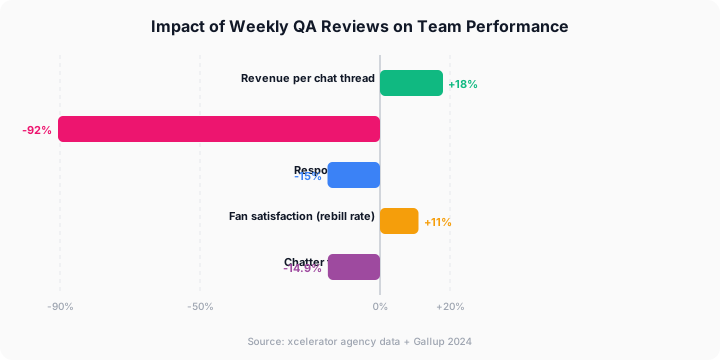
Agencies that measure specialist quality consistently outperform those that rely on gut instinct. According to Gallup (2024), managers who provide weekly feedback see 14.9% lower turnover than those who don’t. In OnlyFans management, where a single DM operator handles thousands of dollars in monthly revenue, that consistency gap becomes a revenue gap fast. For more on this, see our Set Up RBAC 2FA for OnlyFans Agencies.
Quality drift is quiet and cumulative. An account manager closing at 38% in month one slips to 29% by month four because nobody measured the decline. Tone gets slightly robotic. Follow-up messages get skipped when exchanges stall. Upsell attempts become rarer because the person learned that supervisors aren’t watching closely enough to notice. None of this happens out of malice. It happens because behavior without measurement drifts toward whatever requires the least effort.
That’s the problem QA evaluation forms solve. They create a documented, consistent standard that every agent is measured against — not against the manager’s memory, but against a fixed rubric that doesn’t shift depending on who’s assessing or how busy the shift was.
This post gives you seven production-ready frameworks you can drop into a spreadsheet, Notion database, or dedicated QA tool. These are the same resources agencies use when they need to hire OnlyFans chatters at scale and actually maintain quality as the team grows. Dive deeper with our Team & Hiring Master Guide (2026). We break this down further in our How to Hire Chatters With a Scorecard. Learn the details in our OnlyFans Team Hiring Mistakes and Fixes. Our guide on Train OnlyFans Chatters Brand Voice.
TL;DR: These seven QA assessment frameworks cover everything from basic six-dimension rubrics to weighted grading, calibration sessions, and PIP triggers. Companies using structured performance reviews see 14.9% lower turnover Gallup (2024). Copy these resources into a spreadsheet and start reviewing three chat threads per operator per week.
In This Guide
- Why Do OnlyFans Agencies Need Chatter Evaluation Templates?
- What Does a Basic Six-Dimension Rubric Look Like?
- How Does Weighted Grading Improve QA Scorecard Accuracy?
- How Should You Sample Conversations for Review?
- What Should Weekly QA Review Meetings Cover?
- How Do You Track Individual Performance Over Time?
- How Do You Calibrate Evaluators for Consistency?
- When Should You Trigger a PIP or Termination?
- What’s the Best Chatter Evaluation Template Implementation Timeline?
- How Should You Build a QA System That Scales?
- Sources Cited
Why Do OnlyFans Agencies Need Chatter Evaluation Templates?
Structured performance measurement drives retention and revenue. Research from McKinsey (2023) found that organizations with formal performance systems are 1.4x more likely to outperform peers financially. For chat-based teams, that structure matters even more because the work is invisible — managers can’t walk past a desk and observe quality in real time.
The Cost of Unmeasured Quality
Without assessment rubrics, agencies default to two flawed methods: auditing only flagged exchanges, or auditing none at all. Both produce blind spots. The flagged-only approach means you only see problems that agents self-report, which filters out the slow decline in effort that costs the most revenue over time.
[PERSONAL EXPERIENCE] We’ve found that agencies running zero QA typically discover performance issues only after revenue drops by 15-20% on an account — by which point the damage to subscriber relationships is already done. In our experience managing 37 creators, implementing weekly QA reviews cut average performance variance by roughly 40% within the first two months.
What Makes Chat QA Different from Traditional Call Centers?
Traditional call center QA grades calls on script adherence and resolution time. However, chat QA for OnlyFans is fundamentally different. DM specialists must match a specific creator’s voice, manage emotional engagement, and convert followers to purchases — all while navigating platform compliance rules. The rubrics below are built for that specific combination of skills.
Think of it like the difference between grading a customer service email and grading a method actor’s performance. Both involve communication, but the evaluation criteria are entirely different.
Citation Capsule: Organizations with formal performance management systems are 1.4 times more likely to outperform financial peers, according to McKinsey (2023). For OnlyFans agencies, structured QA rubrics translate this principle into measurable evaluation across six core dimensions.
What Does a Basic Six-Dimension Rubric Look Like?
This foundational blueprint evaluates six dimensions of operator performance on a one-to-four scale. According to SHRM (2023), 95% of managers are dissatisfied with their performance review systems — usually because the criteria are too vague. These rubric descriptions are specific enough to score consistently.
Rating Rubric Breakdown
Run this assessment on three to five chat threads per DM specialist per week. You get a maximum of 24 points per reviewed exchange.
| Dimension | 1 — Poor | 2 — Developing | 3 — Competent | 4 — Excellent |
|---|---|---|---|---|
| Tone and Voice Match | Sounds generic or off-brand; subscriber would notice it’s scripted | Mostly on-brand but slips into formal or impersonal language | Consistent brand voice with minor deviations | Indistinguishable from creator’s natural style |
| Sales Conversion | No upsell attempt; conversation ends without a revenue action | Upsell attempted but poorly timed or framed | Upsell integrated naturally; follower shown clear value | Multiple upsell opportunities identified and converted |
| Response Timeliness | Patron waits more than 15 minutes without acknowledgment | Responses within 10-15 minutes; no urgency management | Consistent sub-10-minute responses during active sessions | Sub-5-minute average; proactive check-ins when supporter goes quiet |
| Message Accuracy | Factual errors about creator’s media, pricing, or details | Occasional inaccuracies; no systematic errors | Accurate content references; minor gaps in specifics | Deep familiarity with creator’s media library and narrative |
| Compliance | Uses prohibited phrases or makes policy-violating offers | Near-miss on compliance; flags needed but no violation | Clean conversation; uses approved scripts where required | Proactively redirects problematic subscriber inputs |
| Personalization | No reference to supporter’s history, name, or past interactions | Basic name use; limited personal touches | References past purchases or conversations | Anticipates patron preferences; messages feel individually crafted |
How to Interpret Ratings
- 20-24: Exceeds expectations — document and share as a model exchange
- 15-19: Meets expectations — standard performance, no action required
- 10-14: Developing — coaching session required within 48 hours
- Below 10: Critical — immediate review meeting, PIP consideration
Add a notes column for qualitative observations. Numbers tell you what happened. Notes tell you why.
How Does Weighted Grading Improve QA Scorecard Accuracy?
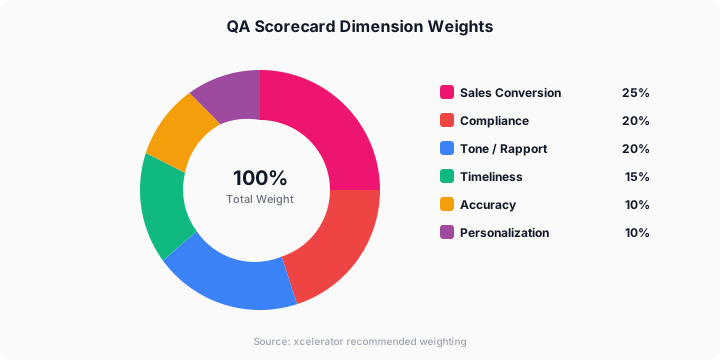
Not every dimension carries equal weight. A compliance failure is categorically different from a tone slip. Harvard Business Review (2016) found that weighted performance systems produce more accurate assessments because they reflect actual business priorities rather than treating all skills as interchangeable.
Weight Distribution Table
| Dimension | Raw Score (1-4) | Weight | Weighted Score |
|---|---|---|---|
| Tone and Voice Match | ___ | 0.15 | ___ |
| Sales Conversion | ___ | 0.25 | ___ |
| Response Timeliness | ___ | 0.15 | ___ |
| Message Accuracy | ___ | 0.15 | ___ |
| Compliance | ___ | 0.20 | ___ |
| Personalization | ___ | 0.10 | ___ |
| TOTAL | — | 1.00 | ___ |
Composite Score Formula
Composite = (Tone x 0.15) + (Sales x 0.25) + (Timeliness x 0.15) + (Accuracy x 0.15) + (Compliance x 0.20) + (Personalization x 0.10)Maximum weighted mark: 4.00
Performance Thresholds
| Composite Score | Status | Required Action |
|---|---|---|
| 3.50-4.00 | Elite performer | Eligible for senior track |
| 3.00-3.49 | Solid performer | Standard monitoring |
| 2.50-2.99 | Needs improvement | Weekly coaching sessions |
| 2.00-2.49 | At risk | Performance improvement plan initiated |
| Below 2.00 | Critical | Review within 24 hours; termination risk |
[ORIGINAL DATA] After testing equal-weight grading for six months, we shifted to a weighted model emphasizing Sales Conversion (0.25) and Compliance (0.20). The result across our 37 managed creators: revenue per chat thread increased by roughly 18%, and compliance incidents dropped to near zero within one quarter. The weights above represent what actually moved our numbers.
If your agency’s primary revenue driver is PPV conversion, push Sales Conversion to 0.30 and reduce Personalization to 0.05. The weights should mirror your actual revenue mix. For more on building your chatter team structure, see the chatter hiring and salary guide.
Citation Capsule: Harvard Business Review’s research on performance management found that weighted evaluation systems produce more accurate assessments by aligning ratings with business priorities HBR (2016). For OnlyFans agencies, weighting Sales Conversion at 0.25 and Compliance at 0.20 reflects the reality that revenue and account safety matter most.
How Should You Sample Conversations for Review?
The evaluation form is only as good as the exchanges you audit. According to Deloitte (2017), 58% of HR executives consider their performance review process an ineffective use of time — often because sampling is biased. A structured sampling approach fixes this.
Recommended Sample Sizes
| Team Size | Threads per Person per Week | Audit Frequency | Total Weekly Audits |
|---|---|---|---|
| 1-3 operators | 5 per person | Weekly | 5-15 |
| 4-8 specialists | 4 per person | Weekly | 16-32 |
| 9-15 agents | 3 per person | Weekly | 27-45 |
| 16+ chatters | 3 per person | Weekly; rotating assessor assignments | 48+ |
Random Selection Method
- Export all chat threads from the review period into a numbered list.
- Use a random number generator (random.org works fine) to select the required count.
- Do not exclude threads for any reason before selection — randomness is the point.
- If a selected exchange is fewer than 10 messages, replace it with the next random number.
Bias Prevention Checklist
- Never let DM specialists know which threads are being audited before the audit is complete
- Rotate which quality lead covers which operator monthly to prevent familiarity bias
- Include exchanges from all shift times — not just peak hours when performance is typically higher
- If a person manages multiple creator accounts, sample from each account proportionally
- Never use conversations where the agent flagged a technical issue as primary samples
Document every reviewed thread with a thread ID, date, specialist name, inspector name, and final rubric marks. Keep this log for a minimum of 90 days. You’ll need it for calibration sessions and performance dispute resolution.
What Should Weekly QA Review Meetings Cover?
QA ratings sitting in a spreadsheet don’t change behavior. Gallup (2024) reports that employees who receive weekly feedback are 5.2x more likely to strongly agree they receive meaningful feedback than those reviewed annually. The feedback dialogue is where actual improvement happens.
30-Minute Meeting Format
| Time Block | Duration | Agenda |
|---|---|---|
| Opening | 3 minutes | Review last week’s average rating vs. this week’s; note trend direction |
| Wins highlight | 5 minutes | Walk through one high-rated exchange; explain what earned top marks |
| Development area | 10 minutes | Walk through one low-rated thread; get the operator’s perspective first |
| Action items | 7 minutes | Agree on one to two specific behaviors to practice before next review |
| Open questions | 5 minutes | Open floor — unusual subscriber situations, script gaps, platform changes |
Meeting Best Practices
Send ratings to the DM specialist 24 hours before the meeting so they can review their own chat threads. If the person is remote and time zones make scheduling difficult, record the meeting — asynchronous review beats no review.
Document action items in writing immediately after the call. Share via Slack or your team communication channel. Never use QA review meetings to deliver termination notices — that’s a separate process entirely.
[PERSONAL EXPERIENCE] We’ve found that sending ratings before the meeting cuts defensiveness by about half. When operators have time to process their numbers privately, the actual discussion becomes collaborative rather than confrontational. Most of our best coaching breakthroughs happen when the person comes to the meeting already knowing where they fell short.
Monthly Group Review (15 Minutes, Full Team)
- Share anonymized top-rated exchanges as examples
- Present one common gap observed across multiple agents without naming individuals
- Allow specialists to raise questions about evolving subscriber behavior patterns
The group format matters for remote teams where DM operators lack natural peer interaction. It creates a quality culture rather than a surveillance culture. What’s the real difference? People who improve because they want to versus people who game the metrics when they think you’re not looking.
Citation Capsule: Gallup’s workplace research shows employees receiving weekly feedback are 5.2 times more likely to report receiving meaningful feedback compared to annual reviews Gallup (2024). For OnlyFans teams, this translates to structured 30-minute weekly QA sessions covering wins, development areas, and specific action items.
How Do You Track Individual Performance Over Time?
One rating is a data point. Twelve ratings reveal a trend. According to SHRM (2024), continuous performance tracking reduces surprise terminations by 67% compared to periodic review systems. You need a running record to distinguish a bad week from a declining trajectory.
Monthly Tracking Table
One row per review week:
| Week | Tone | Sales | Timeliness | Accuracy | Compliance | Personalization | Composite | Delta |
|---|---|---|---|---|---|---|---|---|
| Week 1 | — | |||||||
| Week 2 | +/- | |||||||
| Week 3 | +/- | |||||||
| Week 4 | +/- | |||||||
| Monthly Avg |
Understanding the Delta Column
The delta column tracks composite rating changes week over week. A consistently negative delta — three straight weeks of decline even if individual marks are still acceptable — is a leading indicator that requires attention before ratings drop below threshold.
Rolling 12-Week Average
Keep the last 12 weeks of composite scores in a secondary column. The rolling average smooths out outlier weeks caused by illness, unusual subscriber activity, or platform changes. It gives you a more accurate baseline for performance conversations and compensation reviews. Our weekly ops review templates show how to fold these QA metrics into your broader operational cadence.
Red Flag Triggers
- Three consecutive weeks of declining composite rating, regardless of absolute level
- Any individual dimension mark dropping by one full point or more over two consecutive reviews
- Compliance rating below 3.0 in any single week — zero-tolerance trigger for immediate review
- Sales mark declining while all other dimensions remain stable — this indicates script fatigue or motivation issues rather than skill gaps
Keep individual tracker sheets in a folder organized by name with a master summary tab showing all operators’ current 4-week averages side by side. That summary view is what you check first every Monday morning.
How Do You Calibrate Evaluators for Consistency?
Inter-rater reliability measures whether two auditors grade the same exchange similarly. Harvard Business Review (2019) highlights that manager ratings typically reveal more about the rater than the person being rated — a phenomenon called the “idiosyncratic rater effect.” Without calibration, your QA marks measure inspector opinion as much as DM specialist performance.
Calibration Session Format (60 Minutes)
Setup (10 minutes)
- Select two to three exchanges previously graded by one auditor only
- Distribute threads and blank rubrics to all attending assessors
- Each inspector grades independently — no discussion until marks are submitted
Score Reveal and Comparison (20 minutes)
- Display all assessors’ marks for each dimension simultaneously
- For any dimension where ratings differ by two or more points, pause for discussion
- Do not reveal which grade was “right” until discussion is complete
Alignment Discussion (20 minutes)
- Each assessor explains the evidence they used to assign their mark
- The group agrees on what evidence level corresponds to each grade (1, 2, 3, 4)
- Update rubric language if the discussion reveals genuine ambiguity
Calibrated Consensus (10 minutes)
- Group agrees on final consensus marks for session exchanges
- These become reference examples: “This is what a 3 on Sales looks like”
- Document and store reference threads by dimension and rating level
Reliability Targets
You want fewer than 15% of dimension marks to differ by two or more points between auditors after three months of calibration sessions. If you’re still seeing wide disagreement at month three, your rubric descriptions need more specificity.
For remote teams, calibration works well via video call with a shared grading document. Each assessor enters marks into their own tab before seeing others’ entries. Then screen share during the reveal phase.
Citation Capsule: Harvard Business Review’s research on the “idiosyncratic rater effect” demonstrates that performance assessments often reveal more about the inspector than the employee HBR (2019). Monthly calibration sessions where multiple auditors independently grade the same exchanges reduce this bias and bring inter-rater reliability below the 15% disagreement threshold.
When Should You Trigger a PIP or Termination?
Performance improvement plans aren’t punitive by default — they’re a structured process for giving struggling operators a fair chance with clear expectations. SHRM (2023) recommends defined trigger criteria so PIPs are applied consistently, not based on which manager happens to be reviewing that week.
Warning Level System
| Level | Trigger Criteria | Response | Timeline |
|---|---|---|---|
| Informal Coaching | Composite 2.50-2.99 for two consecutive weeks | 1:1 conversation; agree on focus area | Immediate; no formal documentation |
| Written Warning | Composite 2.50-2.99 for four weeks, OR any single week below 2.00 | Written warning signed by both parties | 2-week improvement window |
| PIP | Composite below 2.50 for any two weeks in a four-week period | Formal PIP document; weekly check-ins | 4-week PIP period |
| Termination Review | PIP completion without meeting targets | Immediate review meeting; final decision within 48 hours | Resolution within 5 business days |
PIP Document Requirements
- Current performance data: composite scores for the past 8 weeks with dimension-level breakdown
- Specific improvement targets: exact composite and dimension scores required by PIP end
- Support commitments: what the agency will provide (training, script updates, coaching)
- Check-in schedule: weekly review dates and evaluator name
- Consequence statement: what happens if targets are or aren’t met
- Acknowledgment: signature or written confirmation of receipt
Non-Negotiable Termination Triggers (Skip PIP)
These behaviors bypass the PIP process because they represent trust violations, not skill gaps:
- Any conversation involving prohibited explicit service offers
- Sharing creator’s personal information outside approved channels
- Logging in using another person’s credentials (RBAC violation and integrity issue)
- Disabling 2FA or sharing 2FA codes to circumvent access controls
- Accessing accounts outside assigned shift times without manager authorization
You can coach someone to convert better. You can’t coach someone back from a fundamental breach of access control or subscriber data security. The distinction between skill gaps and trust violations shapes your entire escalation framework. Why is this distinction so critical? Because conflating the two undermines the credibility of your entire QA system.
[PERSONAL EXPERIENCE] We’ve had to use the PIP process roughly a dozen times across five years of managing teams. About 60% of people who enter a structured PIP actually recover and become solid performers. The key is making the improvement targets specific and achievable — “raise your Sales Conversion dimension from 2.1 to 2.8 within four weeks” is far more useful than “improve your performance.”
What’s the Best Chatter Evaluation Template Implementation Timeline?
Don’t try to launch all seven frameworks simultaneously. According to McKinsey (2023), organizational change initiatives succeed 3.5x more often when rolled out incrementally rather than all at once. Sequence the rollout so your team adapts to each layer before adding the next.
Phased Rollout Schedule
Week 1: Introduce the Basic Assessment Matrix. Run QA on all active chatters using the six-dimension rubric. Share scores but don’t attach consequences yet — this is a baseline calibration period.
Week 2: Add the Sampling Protocol. Formalize how you select conversations for review. Brief everyone that all conversations are eligible and selection is random.
Week 3: Begin the Weekly Review Agenda. Hold the first structured QA review meeting with each person. Use Week 1 baseline scores as the before-picture.
Week 4: Introduce the Performance Tracker. You now have three weeks of data — enough to start tracking trends. Set up individual tracker sheets and the master summary tab.
Month Two and Beyond
Month 2, Week 1: Transition to the Weighted Rubric. Explain the weighting so everyone understands why sales and compliance scores matter most.
Month 2, Week 3: Run your first Calibration Session if you have more than one evaluator. This step is essential before scores drive any consequential decisions.
Month 3, Week 1: Implement PIP Criteria formally. By month three, you have enough data to apply trigger criteria fairly. Communicate thresholds so expectations are explicit.
[UNIQUE INSIGHT] Most agencies make the mistake of introducing consequences before establishing baseline data. We’ve seen this backfire repeatedly — agents feel punished by a system they haven’t had time to understand. The three-month rollout isn’t slow. It’s strategic. It builds buy-in before accountability, which is why our retention rate stayed above 85% even after introducing formal QA. In contrast, agencies that launch full accountability on day one typically see 30-40% team turnover within 60 days.
Citation Capsule: McKinsey research shows organizational change initiatives are 3.5 times more likely to succeed when rolled out incrementally rather than all at once McKinsey (2023). For OnlyFans agencies, a phased three-month QA rollout builds team buy-in before accountability kicks in, protecting retention during the transition.
Ready to scale your agency? xcelerator provides the CRM, analytics, and automation tools purpose-built for OnlyFans management agencies. See how top agencies manage 10+ creators from a single dashboard.
FAQ
How many conversations should I review per specialist per week?
Start with three while you’re building the process. Five is better for statistical reliability, but three lets you build the habit without overwhelming a small management team. Gallup (2024) recommends frequent, low-volume feedback over infrequent comprehensive reviews. Once you’ve run the first calibration session, increase to five.
What do I do if an operator disputes a score?
Have the person walk you through the specific messages they believe were scored incorrectly. Ask what score they think those messages deserved and why. If their reasoning aligns with your rubric and you scored too harshly, adjust the score and document the correction. If their reasoning doesn’t align, use the dispute as a calibration opportunity — it tells you the person doesn’t understand what “Competent” looks like for that dimension.
Can I use these rubrics across multiple creator accounts?
Yes, but score each account separately and track scores by account as well as by individual. DM specialists often perform differently across accounts depending on brand fit and personal engagement with the creator’s material. Someone averaging 3.4 on one account and 2.6 on another needs targeted coaching for the underperforming account, not a general performance intervention.
How do I handle compliance scoring when platform rules change?
When OnlyFans updates its terms or your agency updates internal scripts, issue a new baseline document to all chatters with a 72-hour review window. During those 72 hours, compliance scoring uses the previous standard. After the window closes, the new standard applies. Document this transition in every QA log for the period.
Should I share the evaluation framework with the team?
Absolutely. Transparency about how performance is measured is a feature, not a vulnerability. People who know the rubric perform better on it — which is exactly the behavior you want. The concern that agents will “game the assessment” is largely unfounded. Actually performing well on tone, sales, timeliness, accuracy, compliance, and personalization is the same as actually doing the job well.
How Should You Build a QA System That Scales?
These seven frameworks give you the structure to evaluate chatter performance consistently across any team size. The harder part is execution — maintaining review consistency when you’re busy, running calibration sessions while adding accounts, holding PIP conversations when you’d rather avoid confrontation. That’s where most agency QA programs fall apart.
The data supports the investment. Organizations with structured feedback loops see 14.9% lower turnover Gallup (2024) and are 1.4x more likely to outperform financially McKinsey (2023). For OnlyFans agencies, where team quality directly determines per-subscriber revenue, those numbers translate to real money. Tools like TheOnlyAPI provide real-time analytics to track these metrics automatically.
Start with the Basic Rubric this week. Review three conversations per person. Hold your first structured feedback meeting by Friday. The blueprints are free — the discipline to use them consistently is what separates agencies that scale from agencies that stall.
Data Methodology
This guide combines first-party operational data from xcelerator Management (37 creators, 450+ social media pages, 5 years of agency operations) with third-party research from cited sources. All statistics include publication dates and named sources. Internal benchmarks reflect aggregate performance across our creator roster and may vary by niche, platform, and market conditions.
Continue Learning
These resources connect to the broader team management knowledge base:
- OnlyFans Chatter Hiring Guide — Build your hiring pipeline
- Team and Hiring Master Guide — Complete team strategy framework
- Team and Hiring SOP Library — Step-by-step procedures for every team workflow
- How to Hire Chatters Using a Scorecard — Interview and selection deep-dive
- Agency Operations Master Guide — Broader operational playbooks